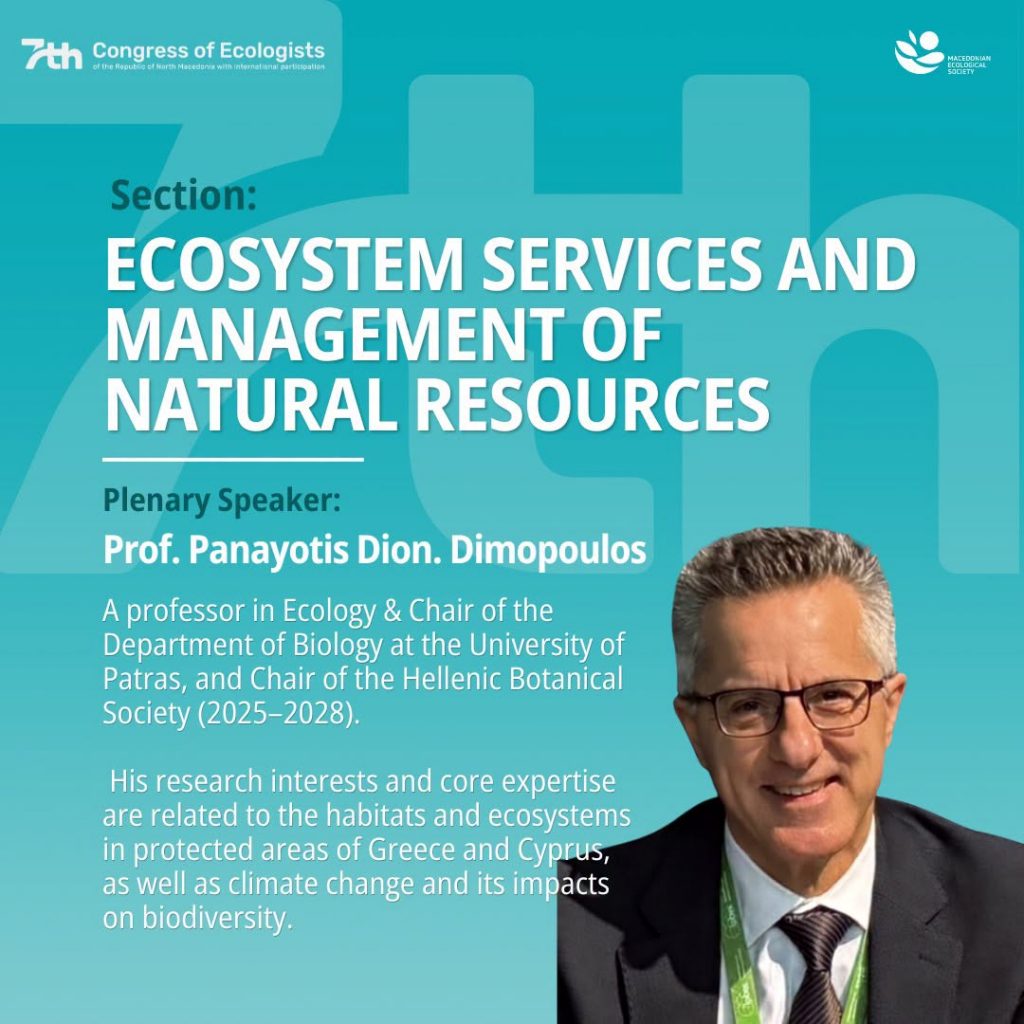
ECOSYSTEM SERVICES AND MANAGEMENT OF NATURAL RESOURCES focuses on the assessment, valuation, and sustainable management of natural resources and the impacts of global environmental change, including climate change, on the ecosystem services they provide. The section addresses the role of ecosystems in supporting provisioning, regulating, cultural, and supporting services, and examines the impacts of human activities and environmental change on these services. Contributions on monitoring, mapping, and modelling ecosystem services, as well as strategies for their conservation, sustainable use, resilience, adaptation, and restoration, are encouraged. Emphasis is placed on interdisciplinary approaches that integrate ecological, social, and economic perspectives to inform evidence-based management, policy development, and decision-making. This section provides a platform for research linking the scientific understanding of ecosystem functions with practical solutions for the management of change across multiple domains.
7th Congress of Ecologists of the Republic of Macedonia
Plenary Speaker: Panayotis Dion. Dimopoulos
Panayotis Dion. Dimopoulos is a professor in Ecology & Chair of the Department of Biology at the University of Patras, Chair of the Hellenic Botanical Society (2025–2028). He has also served as Chair of the National Committee for Natura 2000 Protected Areas (2020–2024). He has been the principal investigator and coordinator of 45 national and 22 European projects and has given 130 presentations at international and national conferences.
His research interests and core expertise are in the fields of monitoring, assessment, and mapping of habitats and ecosystems in protected areas of Greece and Cyprus, as well as climate change and its impacts on biodiversity.
Lecture title: Beyond Assessment: Translating Ecosystem Services into Real-World Decisions and Transformative Action
Еcosystem services valuation has matured scientifically over decades, yet the gap between knowledge and action remains wide. In times of accelerating biodiversity loss, climate disruption, and resource scarcity, it becomes vitally important to move beyond the technical assessment of ecosystem services – such as clean water provision, carbon sequestration, biodiversity support, and cultural benefits – to their practical integration into policymaking, business strategies, and community actions that drive real transformative change.
This can foster sustainable development, align economic incentives with ecological health, and empower nature-based solutions that benefit both people and the planet. But this requires interdisciplinary collaboration, innovative tools and adaptive governance that incorporates stakeholder values and equity considerations, while avoiding pitfalls such as oversimplification of complex ecological trade-offs.
Pairing assessment with deliberate pathways to implementation will undoubtedly help shift societies from reactive environmental management to proactive, regenerative systems that ensure long-term resilience and human well-being in an interconnected world.