Environmental pollution is one of the most pressing global challenges affecting human well-being and ecosystem integrity. Hence, AIR, WATER AND SOIL POLLUTION focuses on all aspects of environmental pollution. The presentations should cover the adverse alteration of environmental media resulting largely from anthropogenic activities, including changes in energy flow, radiation levels, and chemical and physical composition of air, water, soil and biota. These alterations contribute to environmental degradation, manifested through biodiversity loss, declining ecosystem quality, contamination of the atmosphere and food systems, and increased risks to human health. Driven primarily by urbanization, industrialization, climate change, technological development, and intensified resource exploitation, pollution is a complex, multidimensional process requiring interdisciplinary research to understand its sources, mechanisms, impacts, and mitigation strategies.
7th Congress of Ecologists of the Republic of Macedonia
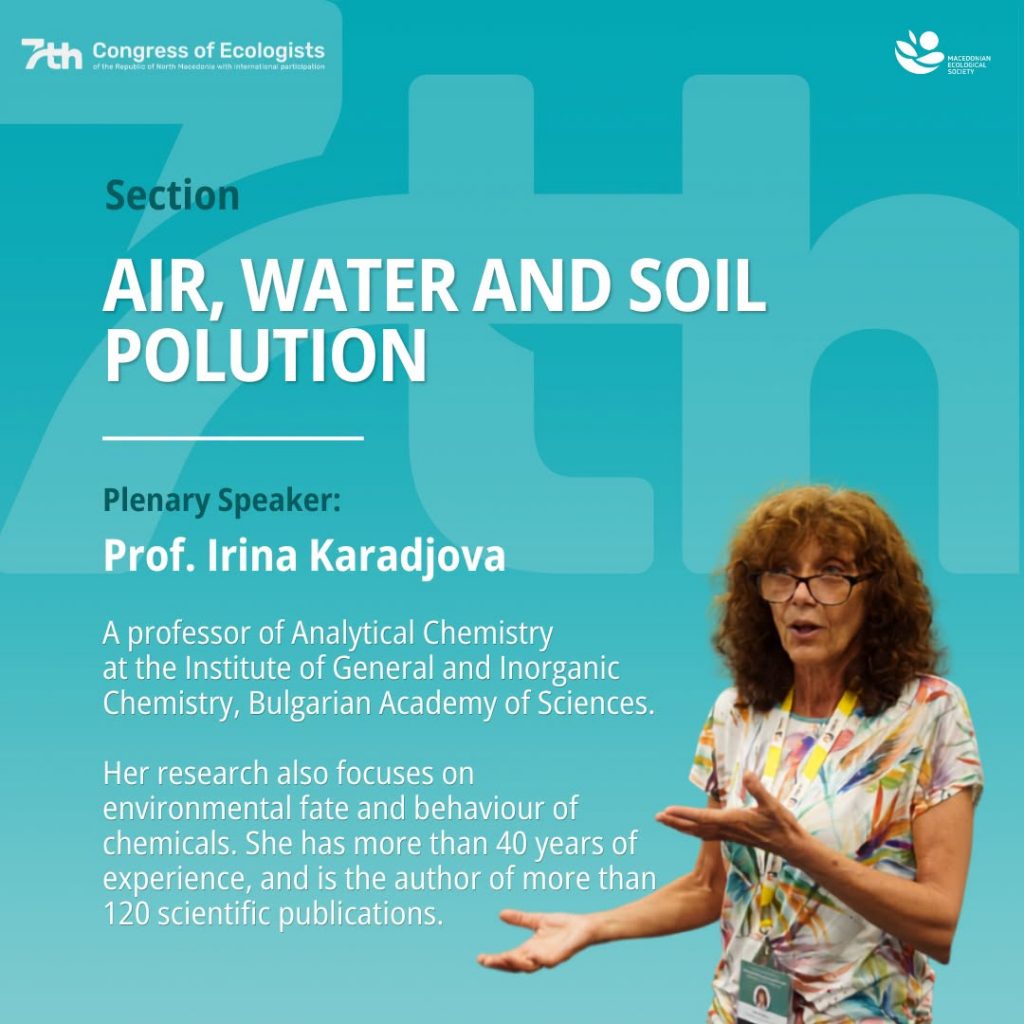
Plenary Speaker: Prof. Irina Karadjova
Prof. Irina Karadjova, PhD is a Professor of Analytical Chemistry with more than 40 years of academic, research, and regulatory experience in environmental chemistry, eco toxicology, analytical toxicology, and chemical risk assessment. She currently serves as Professor at the Institute of General and Inorganic Chemistry, Bulgarian Academy of Sciences.
Her research focuses on environmental fate and behavior of chemicals, environmental exposure assessment, eco toxicity, analytical methods for trace element and chemical species determination, and environmental legislation. She has led numerous national and international research projects and has contributed significantly to the development of Bulgarian legislation concerning the assessment of the chemical status of surface waters.
Prof. Karadjova is the author of more than 120 scientific publications, including 90 papers in peer-reviewed journals with impact factor. Her expertise in chemical risk assessment is reflected in her service as a member of the Risk Assessment Committee (RAC) of the European Chemicals Agency (ECHA), the EURL ECVAM Scientific Advisory Committee (ESAC), the ECHA Bioelution Expert Group, and several national expert bodies related to environmental protection and chemical safety.
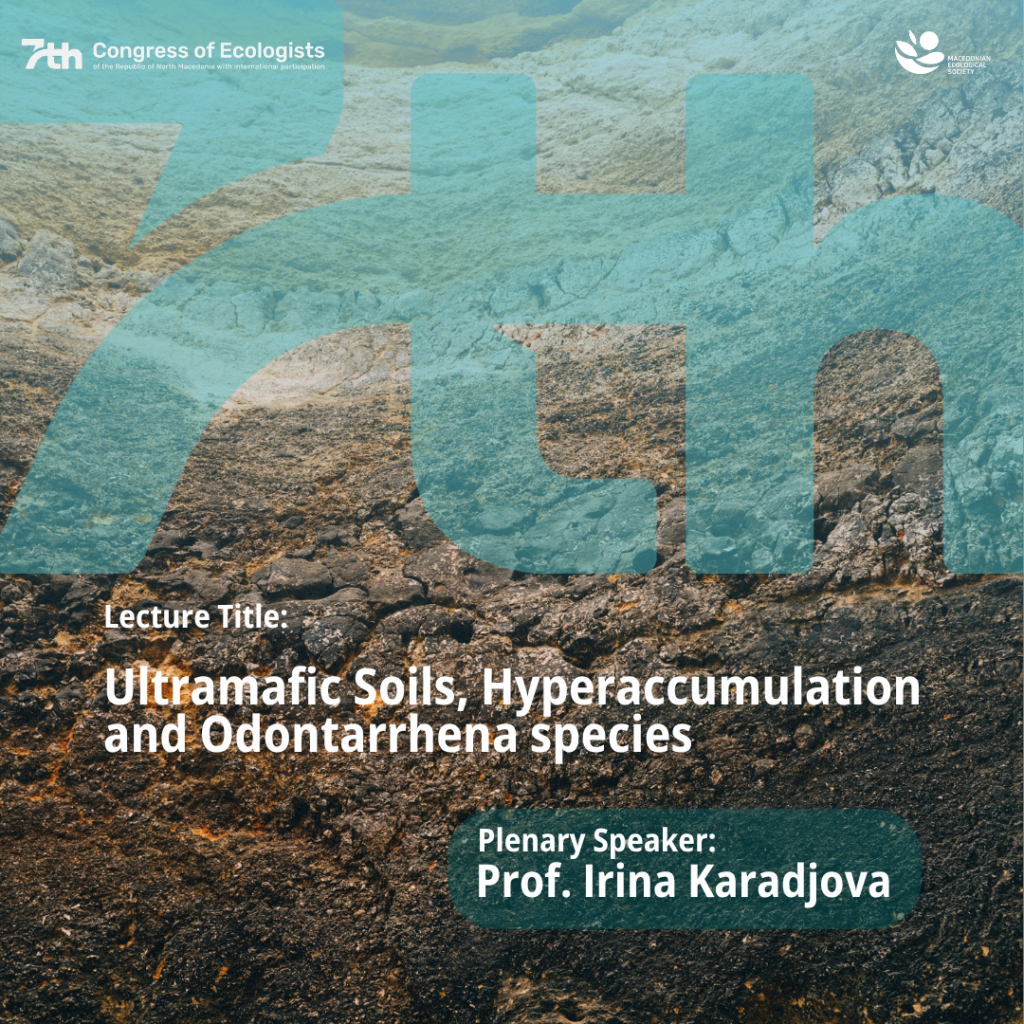
Lecture title: Ultramafic Soils, Hyperaccumulation and Odontarrhena species
This lecture will focus on the chemistry of ultramafic soils and the remarkable ability of some Odontarrhena species to hyperaccumulate nickel. Ultramafic soils are among the most chemically challenging terrestrial environments because they contain high concentrations of potentially toxic metals, low nutrient availability, and highly unbalanced Ca/Mg ratios. These extreme conditions have driven the evolution of unique plant adaptations, making Odontarrhena an excellent model for investigating metal tolerance and accumulation.
By integrating advanced elemental analysis with field and controlled-environment experiments, this research helps us understand how soil chemistry influences metal uptake, transport, and accumulation in different Odontarrhena species, providing new insights related to the plant responses under metal stress.
The findings show that hyperaccumulation is not simply a consequence of growing on metal-rich soils but results from highly specialized physiological and evolutionary adaptations that differ substantially among closely related species.
This contributes to the broader understanding of plant adaptation to extreme environments while providing knowledge that can support sustainable applications such as phytoremediation, phytomining, and the restoration of contaminated land. More generally, it demonstrates how analytical chemistry can provide the quantitative foundation needed to address important questions in environmental science, biodiversity conservation, and the sustainable management of natural resources.