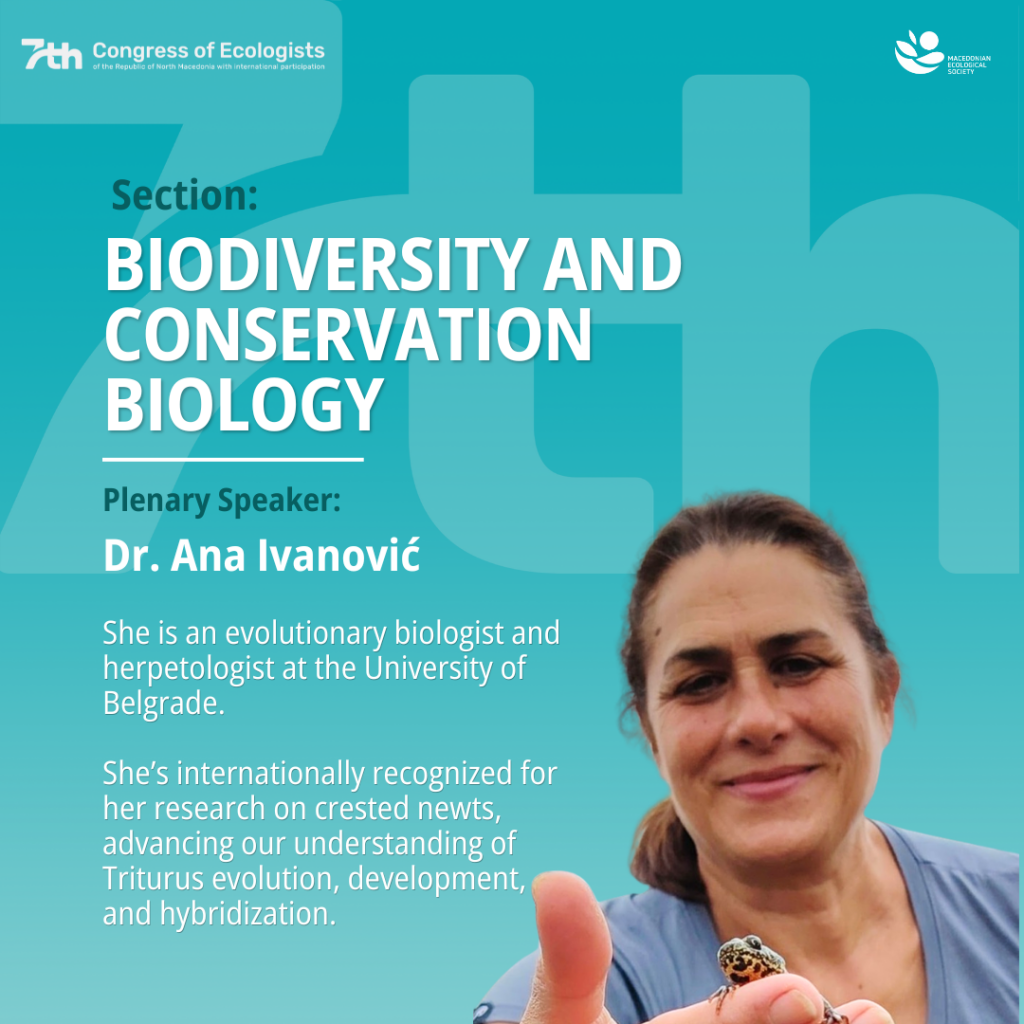
BIODIVERSITY AND CONSERVATION BIOLOGY focuses on research addressing the diversity of living organisms, from genes to species, and their conservation in the face of increasing threats. This section welcomes contributions to species inventories, population monitoring, genetic diversity studies, conservation strategies, ecosystem restoration, and species-specific management. Emphasis is placed on integrative and interdisciplinary approaches that support evidence-based conservation planning and practical measures to ensure the long-term survival of species and the preservation of biological diversity.
7th Congress of Ecologists of the Republic of Macedonia
Plenary Speaker: Dr. Ana Ivanović
Dr. Ana Ivanović is an evolutionary biologist and herpetologist at the University of Belgrade. Internationally recognized for her research on crested newts, she uses long-term field and experimental studies to advance our understanding of Triturus evolution, development, and hybridization. Leading a dedicated team, her research delivers the foundational morphological, life-history, and ecological data essential for the conservation of these unique amphibians.
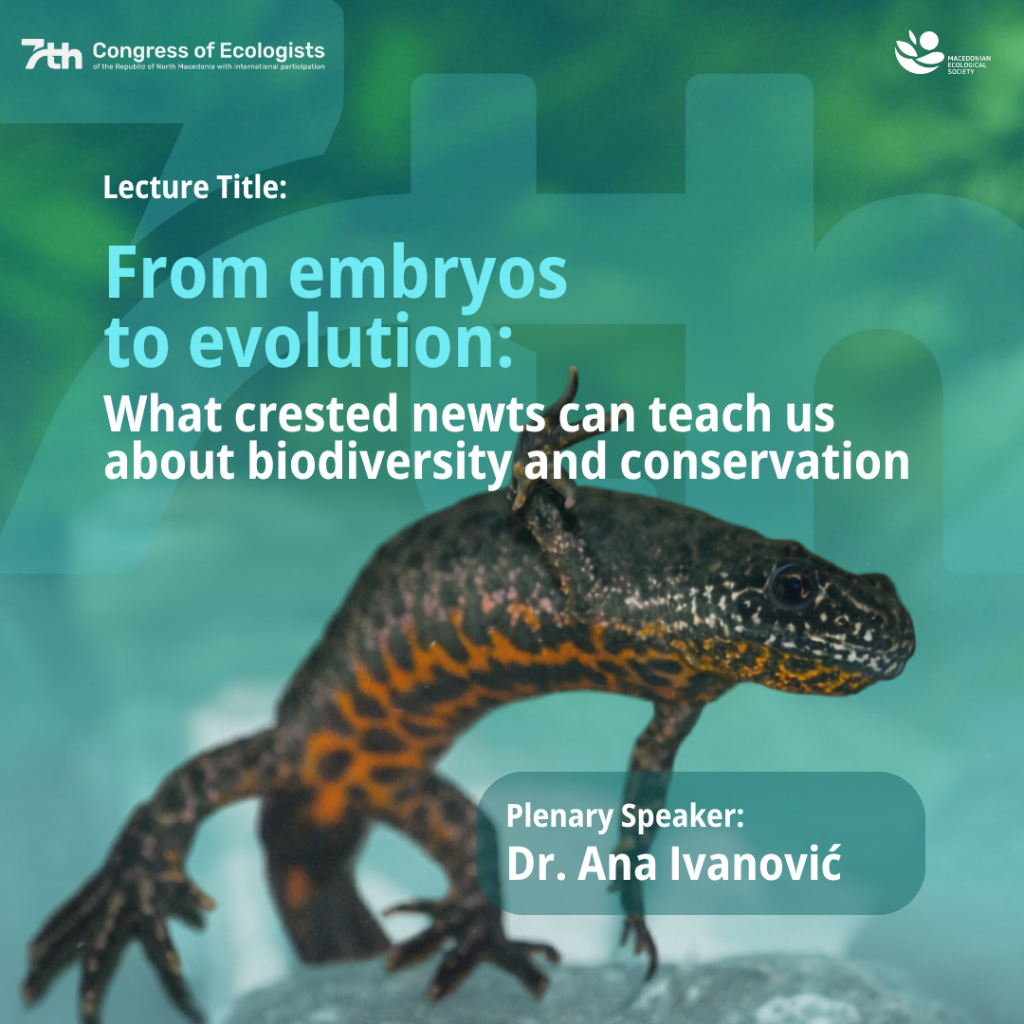
Lecture title: From embryos to evolution: What crested newts can teach us about biodiversity and conservation?
How do closely related species evolve? Why do some animals survive for millions of years despite biological traits that seem to work against evolutionary success? I explore these questions using crested newts (Triturus) – a group of European salamanders that includes two remarkable Balkan species that occur in North Macedonia (T. macedonicus and T. ivanbureschi). By combining developmental biology, life-history studies, evolutionary morphology, and modern 3D imaging, I follow these animals through every stage of life: from embryo to larva, metamorphosed juvenile, and adult – to understand how the diversity of forms we see today evolved.
Crested newts challenge some of our expectations about evolution. They have a remarkable genetic system that causes about half of all embryos to die before hatching, a burden that should make long-term survival difficult. Yet these animals have persisted for millions of years, surviving repeated ice ages and dramatic environmental change. Also, despite deep genetic and phenotypic divergence and clear species boundaries, different species interbreed where they meet. This unusual combination makes them an outstanding natural model for understanding how species evolve, diversify, and spread across landscapes.
But today, the greatest threat to crested newts is not evolutionary. It is us. The ponds and surrounding terrestrial habitats they depend on throughout their life cycle are disappearing because of land-use change, agriculture, urban development, and climate change. Their decline is also a warning that freshwater ecosystems are under increasing pressure. By understanding how crested species evolved and persisted through millions of years of environmental change, we gain more than insight into evolution itself: we gain the knowledge needed to protect these extraordinary animals and the ponds and terrestrial habitats they call home.